
Weld Bevel Angles Explained: 30°, 37.5°, J and K Bevels
Why bevel before welding
Once material gets thicker – often from around 5 mm, depending on the welding process and the penetration required – a square butt joint is no longer enough and the edge needs a bevel. Its shape decides how much filler metal you use, how long welding takes and how much the part distorts. Exact dimensions always come from the welding procedure (WPS); the figures below are typical examples.
Three terms you need to know
A weld preparation is defined by three dimensions: the bevel angle cut on each part, the root face – a small flat strip that prevents burn-through, often 1–2 mm – and the root gap between the parts, often 2–3 mm. All three have to be cut accurately and repeatably to meet the procedure.
The most common bevel types
30° V-bevel
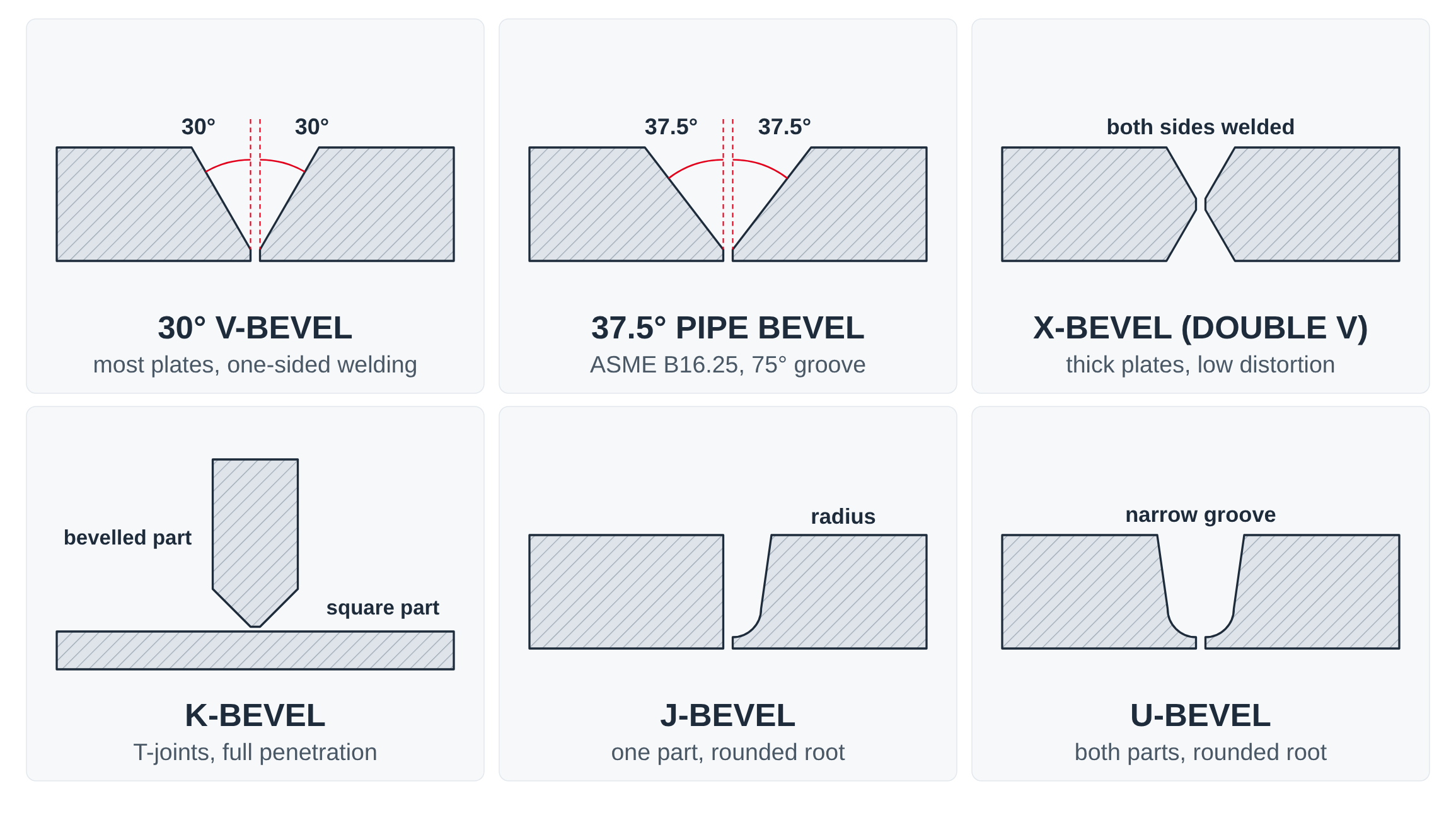
The most common plate preparation: 30° on each part, which gives a 60° included groove angle. Easy to cut and weld, and well suited to plates welded from one side.
37.5° pipe bevel
A widely used pipe end preparation per ASME B16.25: 37.5° with a 1.6 mm root face, forming a 75° groove. European standards such as EN ISO 9692 allow other geometries, so always check which standard your project follows.
X-bevel (double-V)
Both parts of a butt joint are bevelled from the top and the bottom, and the joint is welded from both sides. On thick plates this needs much less weld metal than a single V, and the balanced shrinkage keeps distortion low.
K-bevel
Only one part gets a double-sided bevel, while the other stays square. It is typical for T-joints and corner joints on thick material, where full penetration from both sides is required.
J-bevel and U-bevel
A groove with a rounded bottom stays narrow even at depth. On thicker material this saves filler metal and welding time compared with a V. A J-bevel is cut on one part, a U-groove on both, using a milling head with the matching radius – see our J-bevel case study.
Milling vs. thermal cutting
Plasma and oxy-fuel are fast, but leave a heat-affected zone and oxide that usually need grinding – and on stainless, duplex or Hardox the heat can affect material properties. Milling gives a clean, accurate bevel with no heat input, ready to weld, and is well suited to precise J- and U-bevels. More in Chip-based vs. thermal machining.
Not sure which bevel your job needs?
In short: 30° V for most plates, 37.5° for pipe, X or K when you can weld from both sides, and J or U once the wall gets thick.
Send us your drawing or the material, thickness and bevel you need. We'll recommend a machine to buy or rent – or bevel the parts for you.


contact us with a request or question
Our team of bevelling professionals is here for you every working day.
We answer your questions within 24 hours.
